The Phoenix Suns vs Utah Jazz Match Player Stats have one of the more intriguing inter-conference rivalries in the NBA, with decades of competitive play and exciting matchups. In the 2025-26 NBA season, their meetings continued to showcase both teams’ strengths and individual star performances. This article focuses on a recent Suns vs Jazz matchup, highlighting key player statistics, team trends, and how individual contributions shaped the game’s outcome.
Game Summary: Suns Dominate the Jazz
On October 31, 2025, the Phoenix Suns hosted the Utah Jazz in an NBA contest that quickly tilted in Phoenix’s favor. The Suns seized control early, with a blistering 37-17 first-quarter run, setting the tone for the rest of the game. They never looked back, cruising to a 22-point victory and showcasing offensive balance and defensive intensity. The Jazz struggled to get consistent scoring from their supporting cast, allowing the Suns to maintain their lead throughout.
Key Player Performances
Phoenix Suns
Devin Booker: Superstar Scoring & Playmaking
The Suns’ All-Star guard Devin Booker led the offensive charge with a phenomenal scoring effort. He finished with 33 points on efficient shooting, displaying his ability to score in isolation, off screens, and in pick-and-roll situations. Booker’s impact extended beyond scoring—he also contributed significantly in rebounding and playmaking, posting 33 points, 9 assists, and multiple rebounds, reflecting his two-way influence on the game.
Booker’s command of the offense was evident throughout. He created space for teammates, drew defensive attention, and consistently executed in clutch moments. His finishing at the rim and mid-range jumpers were crucial in maintaining Phoenix’s advantage.
Supporting Cast Contribution
While Booker was the headline, the supporting cast also stepped up:
- Ryan Dunn contributed with solid rebounding and hustle plays, helping Phoenix limit second-chance opportunities for Utah.
- Grayson Allen provided spacing and scoring from the perimeter, hitting timely three-pointers to keep the Jazz defense honest.
Their contributions were essential to maintaining offensive momentum when Booker drew double teams. This balanced offensive attack made it difficult for Utah to focus on one player.
Utah Jazz
Lauri Markkanen: Lone Scoring Force
For the Jazz, Lauri Markkanen was the standout performer. He showcased his scoring prowess with 33 points, including several tough baskets over Phoenix defenders. Markkanen’s ability to score from both the perimeter and inside kept Utah competitive in spurts.
Despite his scoring, Markkanen received minimal help from his teammates, which ultimately limited the Jazz’s chances of a comeback. When other scorers struggled to find rhythm, Markkanen carried the offensive load.
Keyonte George & Walker Kessler
Other contributors on the Jazz included:
- Keyonte George, who added 17 points and 9 rebounds, showing flashes of scoring versatility and aggressiveness.
- Walker Kessler, whose rebounding (13 rebounds) was a bright spot for Utah, helping the Jazz battle on the glass despite Phoenix’s size advantage.
However, the Jazz struggled with turnovers and inconsistent perimeter shooting, which compounded scoring droughts and made it difficult to sustain offensive runs.
Detailed Player Stat Lines (Oct 31, 2025)
Phoenix Suns Individual Stats
| Player | Minutes | Points | Rebounds | Assists | FGM-A | 3PM-A | Turnovers |
| Devin Booker | 34:41 | 33 | 4 | 9 | 10-20 | 3-6 | 2 |
| Grayson Allen | 28:30 | 14 | 2 | 1 | 5-10 | 3-7 | 1 |
| Ryan Dunn | 22:32 | 6 | 7 | 3 | 2-8 | 0-2 | 2 |
Utah Jazz Individual Stats
| Player | Minutes | Points | Rebounds | Assists | FGM-A | 3PM-A | Turnovers |
| Lauri Markkanen | 34:41 | 33 | 4 | 0 | 10-20 | 4-11 | 2 |
| Keyonte George | 32:37 | 17 | 8 | 9 | 3-10 | 2-4 | 3 |
| Walker Kessler | 28:31 | 4 | 13 | 1 | 2-5 | 0-0 | 3 |
| Svi Mykhailiuk | 22:51 | 0 | 3 | 1 | 0-5 | 0-5 | 1 |
| Ace Bailey | 22:32 | 6 | 7 | 3 | 2-8 | 0-3 | 3 |
How the Stats Reflect Team Strategy
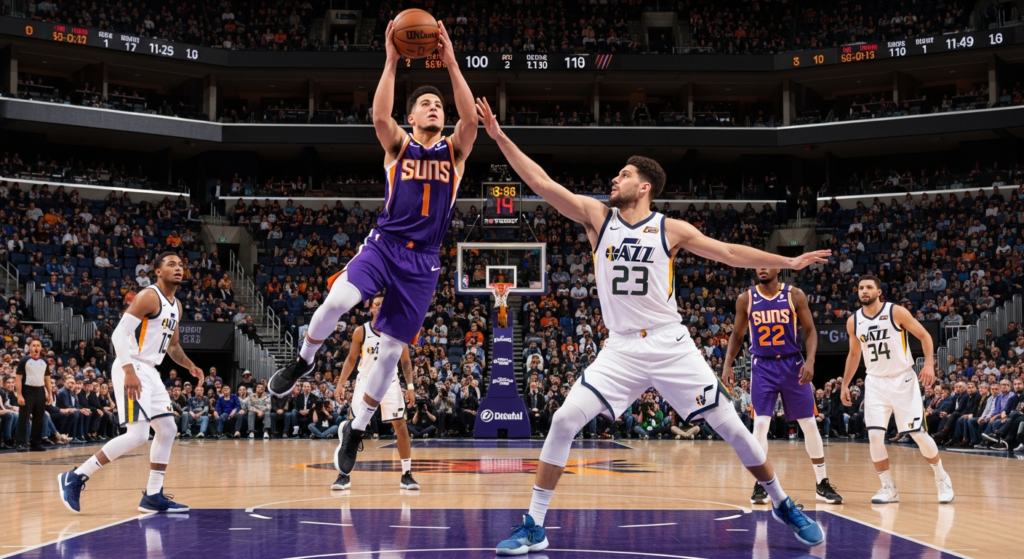
Phoenix’s scoring distribution reflected a well-executed game plan: get the ball to your top scorer while ensuring that role players are ready to contribute. Booker’s high usage did not prevent others like Allen and Dunn from impacting the scoreboard. The Suns moved the ball effectively, resulting in balanced shot attempts and high-percentage looks.
Spacing on offense—especially with multiple shooters knocking down long-range shots—kept Utah’s defense stretched. This spacing allowed Booker to isolate when needed and exploit defensive mismatches.
Utah Jazz Struggles with Consistency
On the other side, the Jazz offense was heavily reliant on Markkanen’s scoring. While he delivered, teammates were inconsistent, especially from beyond the arc. Limited perimeter shooting success and turnovers hampered their ability to build sustainable momentum.
Utah’s defense struggled to contain Booker and the Suns’ shooters. Phoenix’s ability to spread the floor and attack in transition opened up scoring opportunities that the Jazz couldn’t counter.
Historical Context: Suns vs Jazz Rivalry
The Suns and Jazz have a long history of regular-season contests. Across hundreds of games, the Suns hold a slight edge in wins, but both teams have had stretches of dominance. While this recent result added to Phoenix’s momentum in the 2025-26 season, earlier matches between the two clubs have varied widely in outcome, from close shootouts to blowouts. This variability makes each matchup between these teams worth examining closely, particularly for analysts and fans interested in trends and player development.
Player Development and Future Implications
Suns’ Trajectory
For Phoenix, performances like Booker’s indicate a team with offensive firepower capable of competing deep into the season. If the supporting cast continues to grow and contribute consistently, the Suns could become stronger contenders in the Western Conference.
Jazz’s Rebuild Efforts
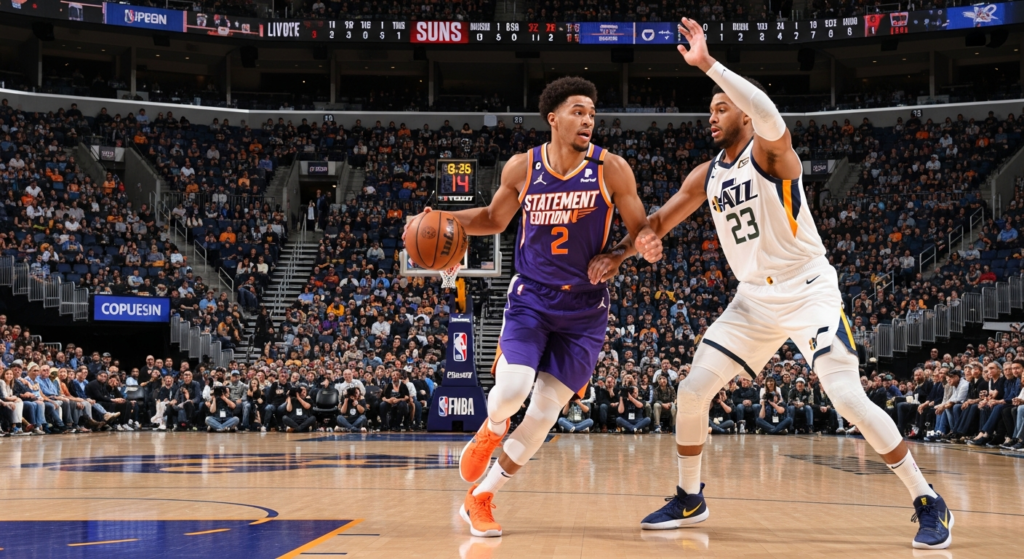
For Utah, the game highlighted areas that need improvement—most notably, diversifying scoring options and limiting turnovers. The Jazz roster has young talent like Keyonte George showing promise, but to elevate their competitiveness, more secondary scoring and defensive stability will be essential.
Conclusion
The Phoenix Suns’ dominant performance over the Utah Jazz highlighted the importance of offensive balance, star leadership, and effective team execution. Devin Booker’s 33-point masterclass, supported by consistent contributions from role players like Grayson Allen and Ryan Dunn, ensured Phoenix controlled the game from start to finish. On the other hand, the Jazz relied heavily on Lauri Markkanen’s scoring, but inconsistent support from the rest of the roster and turnovers prevented them from mounting a serious comeback.
This matchup not only showcased individual talent but also reflected broader team strategies: the Suns demonstrated the strength of a well-rounded offense, while the Jazz revealed areas needing improvement, particularly in secondary scoring and ball security. Looking ahead, Phoenix can build momentum with this performance, while Utah must focus on developing a more consistent supporting cast to complement their star players. Overall, the game was a clear example of how teamwork, depth, and execution can determine the outcome, even when individual talent shines.
FAQs
1. Who were the top scorers in the game?
The Suns’ top scorer was Devin Booker with 33 points, while Lauri Markkanen led the Jazz with 33 points.
2. How did the Suns’ supporting players contribute?
Players like Grayson Allen and Ryan Dunn added important points and spacing, helping Phoenix sustain scoring runs when Booker wasn’t scoring.
3. What were Utah’s main statistical struggles?
The Jazz struggled with turnovers and had inconsistent three-point shooting, which limited sustained offensive pressure.
4. Did any players stand out on defense?
Walker Kessler’s rebounding was a bright spot for Utah, but Phoenix’s team defense overall had a bigger impact.
5. What does this game mean for both teams’ seasons?
For Phoenix, it emphasizes their offensive strength and depth. For Utah, it highlights areas for growth, especially in supporting Markkanen with more consistent offense and better ball security.